

Knee pain can gradually change the way a person walks, climbs stairs, exercises, or even performs simple daily activities. When advanced arthritis or severe joint damage no longer responds adequately to medicines, physiotherapy, injections, or other non-surgical treatments, knee replacement may be considered. Among the newer implant options available today are gold-coloured, coated knee implants. These are sometimes described as “golden knee implants” because of their distinctive appearance. Importantly, the term does not necessarily mean that the implant is made of solid gold. In many systems, the golden appearance comes from a thin ceramic coating such as titanium nitride applied to a metal implant. Such coatings are designed to provide specific surface properties, including hardness, wear resistance, and corrosion resistance.
What Are Golden Knee Implants?
A knee implant replaces the damaged surfaces of the knee rather than replacing the entire bones. During a total knee replacement, the damaged ends of the thigh bone and shin bone are resurfaced with implant components, while a strong polyethylene spacer provides a smooth surface between them. Golden-coloured implants may use a conventional metal alloy underneath with a thin surface coating, commonly titanium nitride or a related coating technology. Titanium nitride has a characteristic gold-yellow colour and is known for its hardness and chemical stability. The purpose of the coating is not simply cosmetic. It is intended to modify the implant surface and may offer advantages such as improved resistance to corrosion and wear. However, the exact material and coating depend on the particular implant system selected by the surgeon.
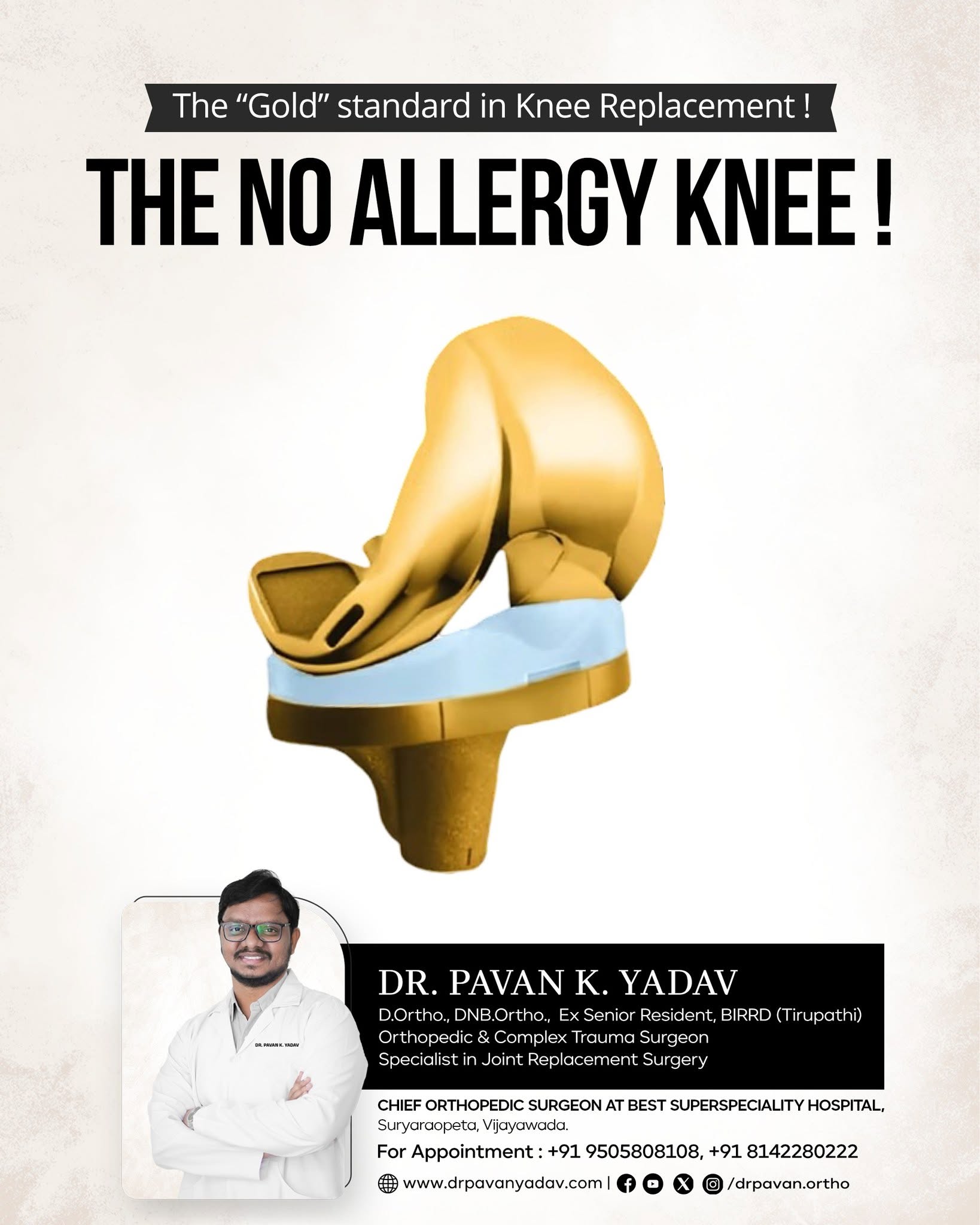
What Are Golden Knee Implants Used For?
Golden-coated implants are used as an alternative implant option during knee replacement surgery. They may be considered for people with advanced osteoarthritis, significant cartilage loss, severe joint damage, deformity, or persistent pain and stiffness that substantially affects daily life. They are not a separate type of operation. The basic principles of knee replacement remain the same: remove the damaged joint surfaces, restore appropriate alignment, and place components that allow the knee to move more smoothly. Implant selection is individualized. The surgeon considers the condition of the knee, bone quality, ligament stability, age, activity level, medical history, and other factors before recommending a particular implant system.
Benefits Of Golden Knee Implants
One potential advantage of coated implants is their surface characteristics. Titanium nitride coatings are designed to provide hardness and resistance to corrosion and wear. Research has also explored their potential role in reducing exposure to certain metal components. For patients with known or suspected sensitivity to certain metals, a coated implant may be considered as part of a personalized treatment strategy. This is why some patients may search for Allergy Free Knee Implants in Vijayawada. However, no implant should automatically be described as completely “allergy-free.” Metal hypersensitivity after knee replacement is uncommon, and the evidence surrounding testing and implant selection remains complex.
Another possible advantage is durability of the implant surface. A hard coating may provide useful wear characteristics, although the long-term success of a knee replacement depends on many factors, not just the coating. It is also important to understand that coated implants have limitations. Studies have reported coating wear and microscopic damage in retrieved implants, so they should not be viewed as automatically superior to every conventional implant.
Golden Knee Implants V/s Conventional Implants
The main difference is usually the surface technology rather than the overall purpose of the implant. Conventional knee implants commonly use metal alloys along with polyethylene components. Coated implants may use a similar underlying metal structure but add a thin ceramic-based surface layer. The coating may provide increased surface hardness and corrosion resistance. It may also reduce direct exposure to some of the underlying metal. Nevertheless, research comparing coated and conventional implants has not consistently shown that coated implants provide better clinical outcomes for every patient. Some studies have found comparable results between coated and conventional knee replacements. Therefore, the “golden” appearance alone should never be the reason for choosing an implant. The design, quality, fixation method, surgical technique, and patient's individual needs are equally important.
Who May Be Suitable For Golden Knee Implants?
There is no single age or activity level that automatically makes someone suitable for a coated implant. A detailed orthopedic assessment is necessary. The surgeon may consider the severity of arthritis, amount of bone damage, ligament condition, alignment of the leg, bone quality, activity expectations, previous surgeries, medical conditions, and any history suggesting metal sensitivity. A patient with a known metal allergy may require additional discussion about implant materials. However, routine allergy testing is not recommended for everyone before knee replacement, and implant selection should be based on the complete clinical picture.
How Is Knee Replacement With Golden Implants Performed?
The process begins with a clinical examination and appropriate imaging, usually including X-rays. The surgeon assesses the extent of joint damage and determines whether total or partial knee replacement is appropriate. Before surgery, medical conditions are reviewed and the patient is prepared for anesthesia and rehabilitation. During the operation, damaged cartilage and a small amount of underlying bone are removed. The selected femoral and tibial components are then positioned carefully, with a polyethylene spacer placed between them. Depending on the case, the kneecap may also be resurfaced. Precise positioning and alignment are important because they can influence knee function and implant longevity. For patients considering Knee Joint Replacement in Vijayawada, understanding the surgical process can help them prepare for treatment and recovery.
How Long Do Golden Knee Implants Last?
No knee implant has a guaranteed lifetime. Modern knee replacements can function successfully for many years, but longevity varies from person to person. Factors such as implant positioning, fixation, body weight, activity level, bone quality, joint stability, and general health can influence long-term performance. Excessive high-impact activity may place additional stress on the replacement. Regular follow-up allows the surgeon to assess the knee and identify potential problems early. The implant's coating is only one part of the overall system responsible for long-term performance.
Recovery After Knee Replacement With Golden Implants
Recovery starts soon after surgery. Patients are generally encouraged to begin moving the knee and walking with appropriate support according to their surgeon's rehabilitation plan. Physiotherapy focuses on restoring knee movement, strengthening the muscles around the joint, improving balance, and gradually increasing walking ability. Pain and swelling are managed with prescribed medication, ice, elevation, and activity modification when appropriate. Most patients gradually return to everyday activities as strength and mobility improve. The timing differs between individuals, so rehabilitation should progress according to recovery rather than a fixed timetable.
Are Golden Knee Implants Suitable For Everyone?
Golden-coated implants are not automatically better for every patient. They are one of several implant choices available for knee replacement. For someone considering Golden Knee Implants in Vijayawada, the most important question is not simply whether the implant has a gold-coloured coating. The important questions are whether the implant is appropriate for the patient's anatomy, medical history, lifestyle, bone quality, and long-term treatment goals. An experienced orthopedic specialist can discuss the advantages and limitations of different implant systems and help the patient make an informed decision.
Choosing The Right Knee Replacement
Successful knee replacement depends on much more than the implant material. Careful diagnosis, appropriate implant selection, accurate surgical technique, infection prevention, pain management, and structured rehabilitation all contribute to recovery. Discussing available implant choices directly with a qualified orthopedician can help clarify which option is appropriate.
Patients can consult Dr. Pavan Yadav for an individualized assessment of knee pain, joint damage, and possible replacement options. The goal is to select a treatment that fits the patient's condition rather than choosing an implant based only on appearance or marketing claims.
Conclusion
Golden knee implants represent an interesting development in knee replacement technology. Their gold appearance generally comes from a specialized surface coating rather than solid gold, and these coatings are designed to provide properties such as hardness, corrosion resistance, and biocompatibility. However, they are not a universal solution. Evidence suggests that coated implants can provide outcomes comparable with conventional systems, while questions about long-term coating performance and the true clinical benefit for metal-sensitive patients continue to be studied.
The best implant is the one that matches the patient's individual anatomy, health, expectations, and surgical requirements. If you are experiencing severe knee pain or have been advised to consider replacement, consult the Best Orthopedician in Vijayawada to understand your options before making a decision.
Take The Next Step
If persistent knee pain is limiting your walking, work, sleep, or everyday activities, an orthopedic evaluation can help determine whether conservative treatment or knee replacement is appropriate. Discuss your symptoms and implant options with an experienced orthopedic specialist to understand whether a coated knee implant may be suitable for your individual needs.
Frequently Asked Questions (FAQs)
1. Are golden knee implants actually made of gold?
Not necessarily. The term usually refers to the gold-coloured appearance of a specialized surface coating, such as titanium nitride, applied to an underlying implant material. The exact construction varies by manufacturer and implant system.
2. Are golden knee implants better than conventional implants?
Not for everyone. Coated implants have specific surface properties, but clinical studies have generally found that their outcomes can be comparable to conventional implants. The appropriate choice depends on individual patient factors.
3. Can golden-coated implants help people with metal sensitivity?
They may be considered in selected patients with suspected or documented metal sensitivity. However, they should not automatically be considered completely allergy-free, and implant selection requires individualized medical assessment.
4. How soon can I walk after knee replacement?
Many patients begin standing and walking with assistance soon after surgery, depending on their health, surgical findings, and doctor's instructions. Physiotherapy then helps gradually improve strength, movement, and confidence.
5. What should I consider before choosing a knee implant?
Consider the severity of your knee damage, bone and ligament condition, medical history, activity goals, implant design, surgeon's experience, and rehabilitation plan. A detailed consultation is more important than choosing an implant based solely on its material or appearance.